Top Tech Trends That characterized 2025
As the year ends, it’s time to take stock of what the Tech industry looked like. Like so many sectors, the tech industry 2025 has been a mixed bug. As expected, we have experienced massive expansion in AI integration with so many tools coming into the market while on the flip side it’s the same year that has been characterized with AI bubble rumors throwing so many investors into panic mode. Here are some of the notable trends and events that defined the Tech industry in 2025.
- AI Expansion and Automation
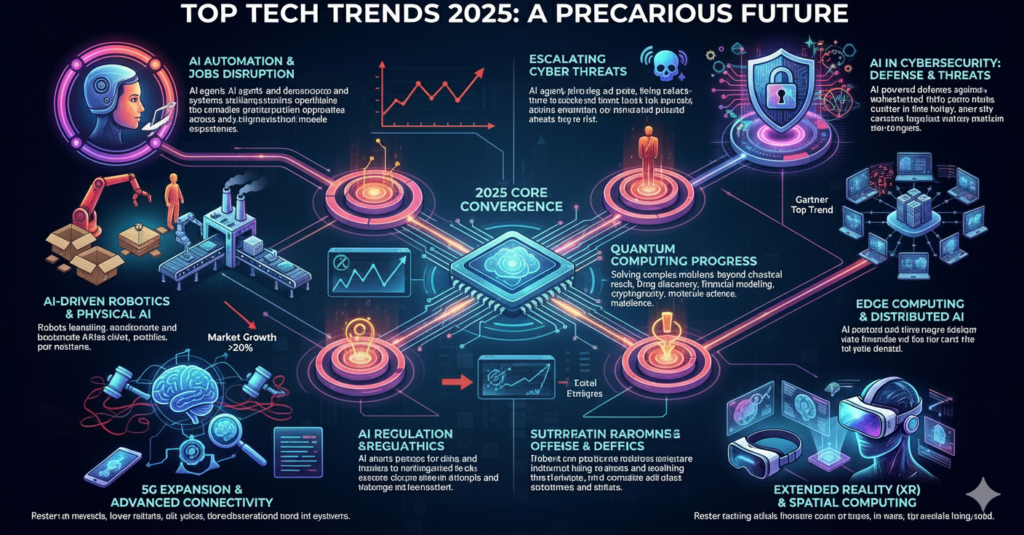
As many industry experts predicted at the end of last year, this year would see a rise in the race to make AI autonomous systems practical. For the last few years generative AI was the key thing, however this year has experienced an increased embrace of AI agents that can reason and execute multiple step tasks without requiring human intervention. This will be the next wave of investments as businesses seek to make AI usage profitable, something most businesses are struggling with.
- Mass layoffs
Just like last year, 2025 has been characterized by mass layoffs in the Tech industry. From new entrants to more experienced folks no one was safe from the year of long knives. The bloodbath has been excruciating. According to tech layoffs tracker trueup.io,an average of 598 people has been laid off since January. This has been attributed to AI takeover as well as other factors such as economic downturn.
- Cyber Threats
There has been unprecedented increase in cyber breaches this year thanks to AI-powered attacks, phishing and human errors. There has been a challenge of AI defense failing to keep up with AI driven attacks. From small startups to big global brands no one was spared. Some of the notable breaches this year include Jaguar Land Rover where ransomware disrupted the manufacturing and retail operations causing the company an estimated 1.9B euros. This ended up halting operations for several weeks. Hackers also infiltrated conglomerate Kering, services stealing data from luxurious fashion brands like Gucci and Balenciaga. In China researcher uncovered that has exposed over 4 billion user records from platforms including WeChat and Alipay. In September there was a cyber-attack on Collins Aerospace, a provider for check-ins and boarding systems in several European Airports that resulted in flight delays.
- AI Regulations
With the AI disruptions came with new challenges. The debate has always been there; how much should AI be regulated? The question wasn’t if, but when the regulations on AI were coming. Like the popular geopolitical maxim goes to America creates, China replicates and Europe regulate Europe quickly absorbed their position and became the first to create a comprehensive act for regulating AI.
The EU act is the first comprehensive law for AI. The regulation is layered based on risk. First banning unacceptable uses like social scoring, imposing strict rules on high-risk applications e.g. employment law enforcement.2ndly the regulation also requires addition transparency for limited risks e.g.: deepfakes and chatbots while leaving low-risk systems largely unregulated aiming for trust-worthy. There has been obvious backlash from big tech, but EU is known for taking Stance.
In conclusion, it’s been a very unstable year in the tech world and that stability isn’t in the horizon yet. The AI bubble has popped up yet but it’s inevitable so we will have to wait and see what 2026 has in store for the industry.